


SCRAP THE APP. Before it scraps YOU.
They sold us (probably not those reading!) the NHS App as the golden key to modern healthcare: instant access to records, appointments, test results, prescriptions, all at your fingertips. "Convenient," they said. "Empowering," they promised. But peel back the glossy interface, and it's a trapdoor straight into digital hell.
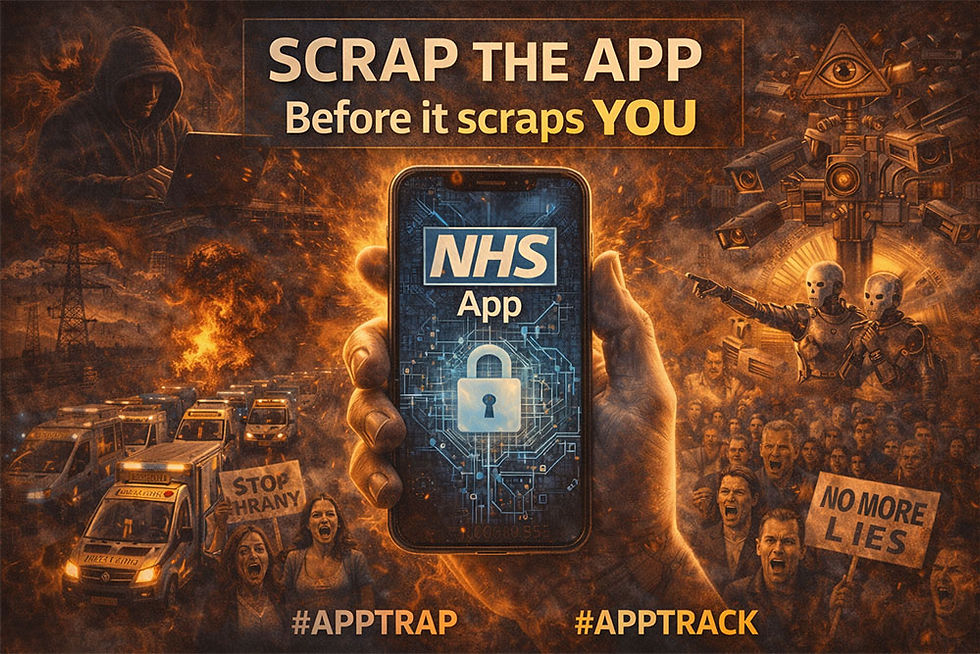
The dangers pile up faster than the notifications.
Wrong information and false positives haunt the system. Inaccurate records, missing details, garbled test results, outdated allergies, don’t appear to be rare glitches; they're a persistent threat. Nearly one in four people spot errors in their NHS records, from wrong personal details to critical clinical mistakes. Doctors and nurses rely on these digital summaries, but when the data is wrong, treatments go wrong. One small mistake could lead to a very different outcome.
Wrong medication doses. Delayed diagnoses. Misidentification that leads to harm, or worse. Patient safety watchdogs have documented cases where electronic systems contributed to deaths: a child given incorrect blood thinners because of entry errors, unresponsive patients wrongly flagged as "do not resuscitate." False positives in results? They trigger unnecessary panic, invasive follow-ups, wasted resources. False negatives? Life-threatening delays. This isn't empowerment, it's Russian roulette with your health.
Then comes the ‘misinformation flood’. The app funnels us toward "trusted" sources, but the broader digital health world is really linked apps, AI advice, wellness trackers and health chat bots who appear to drown us out in misleading claims. People in desperation turn to unverified wellness tools or chatbots that manipulate the facts, spreading vaccine hesitancy, fake cures, dangerous diets. Experts warn this risks a "lost generation" sicker and less trusting of real medicine. The app doesn't shield us; far from it, it plugs us deeper into the misinformation ecosystem.
But that is not all. What if the power goes down? Blackouts, cyber outages, system crashes which could be sudden and total. No access to records during emergencies. No prescriptions. No way to prove allergies or medications to a doctor in A&E. Hospitals grind to a halt when IT fails; we've seen it cripple services before. Lives hang on servers that can go dark.
And, what if your data gets hacked? It’s a reasonable question. Already we have seen it happen. Yes, NHS breaches DO happen via ransomware gangs, supplier vulnerabilities, Oracle flaws exposing files by the hundreds of thousands. Sensitive medical histories, mental health notes, genetic info leaked, where exactly? Which cloud? Maybe it will be a ‘dark’ cloud on the dark web. Identity theft shortly follows. Then what? Blackmail and extortion targeting vulnerable patients? Scammers are now capable of phishing with fake GP texts. Stolen data fuels fraud, stigma, discrimination. Healthcare suffers the highest breach costs as your most intimate details are sold cheap.
What if you lose your phone? Your entire health life locked behind biometrics and passwords now sits in a thief's hands, or lost forever if you can't recover access. No quick fallback to paper. No human at the surgery who can override the digital wall without endless verification. No one even to complain to or ask for advice/help. You're cut off from your own care.This isn't safety. Its fragility dressed as progress. Madness dressed as safety and security. Centralized digital dependency creates massive single points of failure: we are all just one hack, one outage, one glitch away from chaos. They call it convenience to herd us into surveillance and control. Track every symptom, every appointment, every refusal, build profiles for "efficiency" or worse.
Have we had enough? Enough of propaganda. The NHS App isn't the key to better health; it's the lock on our freedom. We need real options: paper records, face-to-face consultations with people we trust with empathy, who will do us no harm. True care comes from reliable humans, not glitchy portals.
Reclaim control before the next blackout, breach, or bad data kills more than convenience. Because when the screen goes blank, the iron rod tightens, we're left in the dark. Fact.
They sold us convenience as the ultimate prize. One login for everything. One app to rule our lives. AI chatbots handling our queries. Next-day deliveries dropping at our door. Smart meters quietly tracking our every appliance. Work-from-home setups blurring the line between office and home. Instant access to our own money, if we can just clear the endless security hoops and remember the multitude of passwords. This isn’t convenience, its utter inconvenience. It’s enough to send you crazy, but that of course is what they want. They promised it would make life easier. Instead, it's made us prisoners in our own digital cages. Enjoy the view, it won’t change in a hurry, it will get even darker.
Every “convenient” step forward strips away a piece of control. We download apps we never asked for, just to access basic services, because we HAVE to or risk being locked out. We juggle passwords, two-factor codes, and biometric scans that feel more like interrogations than logins. We wait on hold for hours, only to speak to a chatbot that loops uselessly and knows nothing about our real problem. When we finally reach a human—if we ever do—they're scripted, distant, powerless.
Smart meters spy on our homes under the guise of “saving us the trouble” of reading dials. Food arrives at our door, but the data trail reveals our habits, preferences, and routines to corporations and governments. Our bank accounts demand facial scans or endless verifications to release our own money. Everything is tracked, logged, analysed not to protect us, but to profile us.
This isn't convenience. Its engineered frustration wrapped in shiny packaging. Its propaganda dressed as progress.
We were promised liberation through technology. What we got was dependence and addiction to a black screen. Slave to smart technology. Feels more like stupidity to many. Exhaustion from navigating broken systems. Alienation from speaking to machines instead of people. A slow erosion of human interaction, replaced by cold algorithms that don't care.
Enough.
It's time to reclaim what makes us human: direct conversations, face-to-face dealings, analogue choices. Real convenience comes from simplicity, talking to a person who listens, reading our own meter if we want, paying with cash without suspicion, living without every move logged for someone else's profit or power. We don't need more apps, more automation, more “smart” intrusions. We need less control from above and more control in our own hands.
Let's stop trading our autonomy for promised ease that never arrives. Let's demand systems that serve us, not rule us. Because true convenience isn't frictionless tracking, it's the freedom to be human again, without permission, without surveillance, without apology.
The iron rod isn't coming tomorrow. It's already here, disguised as the next “convenient” update. Time to push back.


Comments